
FIFA meeting on February 16 could rewrite 2026 World Cup qualification for Nigeria.
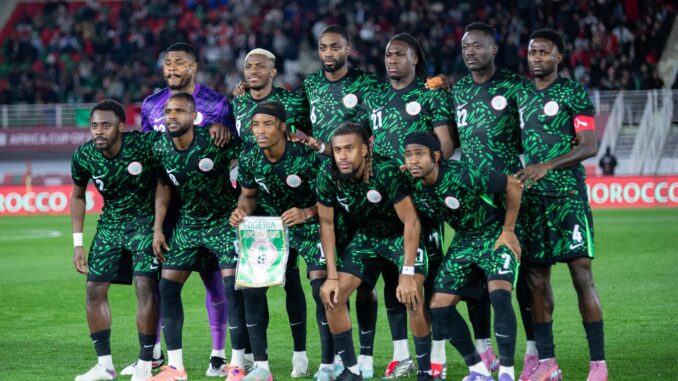
The 2026 FIFA World Cup qualification narrative for Nigeria has taken a dramatic turn as **FIFA prepares to rule on the Nigeria Football Federation’s (NFF) petition against the Democratic Republic of Congo regarding player eligibility — a decision that could restore the Super Eagles’ hopes of securing a World Cup ticket.
The world football governing body has scheduled a pivotal meeting for Monday, February 16, 2026, where FIFA’s Disciplinary Committee will examine Nigeria’s complaint accusing DR Congo of fielding ineligible players during the African playoff final in November 2025 — a match the Super Eagles lost 4–3 on penalties after a 1–1 draw in Rabat, Morocco.
What Nigeria Is Arguing
The NFF petition, submitted in mid-December 2025, alleges that several DR Congo players who featured in that decisive game did not meet FIFA’s eligibility requirements due to improper nationality switches and potential conflicts with DR Congo’s domestic citizenship laws.
According to the NFF, some players cleared by FIFA may hold dual nationalities potentially contravening Congolese law and this may have misled FIFA’s clearance process.
NFF General Secretary Dr. Mohammed Sanusi has reaffirmed the federation’s confidence in its evidence, insisting that the complaint followed proper procedural channels and that Nigeria has a strong case if the documentation and legal arguments are compelling.
The Stakes: World Cup Qualification and Intercontinental Playoffs
A ruling in Nigeria’s favour would change the official result of that playoff match, likely disqualifying DR Congo and reinstating the Super Eagles into the six-team intercontinental playoff tournament scheduled for March in Mexico. Success there would secure one of the final African spots at the expanded 2026 FIFA World Cup, co-hosted by the United States, Canada, and Mexico.
Super Eagles midfielder Alex Iwobi has publicly voiced optimism about the appeal, describing the decision as “still in play” and expressing hope that Nigeria’s World Cup journey might not be over yet.
Controversy and Reaction
Reactions to the petition have been mixed. Supporters argue that FIFA needs to uphold the integrity of its eligibility rules, while critics question whether domestic nationality laws should influence international football eligibility, given that FIFA bases eligibility primarily on passports and documented national association clearances.
The Democratic Republic of Congo, for its part, has dismissed criticism and labelled Nigeria’s protest as sour grapes maintaining that its players were cleared appropriately under FIFA statutes.
What Comes Next
FIFA’s ruling on February 16 will not only determine whether the Super Eagles will still have a shot at World Cup qualification, but also set a precedent for how eligibility disputes; especially those involving nationality complexities are adjudicated ahead of global tournaments.
If either federation is dissatisfied with FIFA’s ruling, both Nigeria and DR Congo reportedly retain the right to escalate the matter to the Court of Arbitration for Sport (CAS).